Let’s talk about ghee, ba-by.
Let’s talk about oil and ghee.
Let’s talk about all the good things, and the bad things, that may be.
Let’s talk aboouuuttt ghee.
Don’t worry, I’m finished. No more singing.
During a now more frequent and practically patented ‘Mum Lecture’, I was receiving a rundown on the carcinogenic potential of vegetable based oils due to low smoke points and free radicals. Now, I hear ‘free radicals’ and my brain fills the gap with some pretty powerful, ‘lana-del-ray-esque, young and cool and roaming a trendy desertscape in a hot leather jacket’ style imagery. Apparently free radicals are NOT as cool as they sound. This particular lecture went on to include a whole lot of rubbish that actually went over my head, probably because by this stage I was mentally fixated on Lana Del Ray circa ‘Ride’. But then she used it to lovingly fry me some eggs, and I decided to look into it. It’s kinda like butter. And I love butter.
Did you know you shouldn’t be frying with olive oil? I didn’t. I used it for everything, in every application that some sort of food related lubricant was required. The interwebs tells us we shouldn’t always go straight to the oil for the following reasons:
- Low smoke point. Quite literally the point at which oil starts to smoke. When oil has surpassed this temperature, it can change the chemical compounds and is potentially harmful.
- Free radicals. When oils are heated to the point that their chemical structure is compromised, free radicals can form and have carcinogenic properties.
- There are different oils, categorised into different types of fat, all with different compounds and structures. Some are more stable than others for different cooking processes (like saturated fat in high heat) so it’s worth using the right oil for the right application.
All that aside, let’s take a few moments to bask in the golden glory of Ghee and why you need it in your life.
What is ghee? Ghee is a form of clarified butter which is traditionally used in Indian cooking, and has been around for a very long time. Like the ancient times. Through a heating process, water and milk solids are removed from raw, unsalted butter and ghee is the delicious goodness that remains.
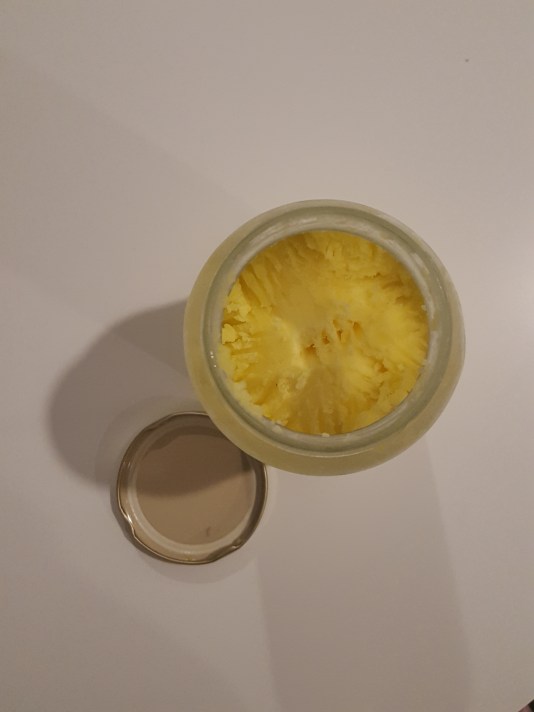
Why am I using it? Basically my mum told me to. And…
- As a saturated fat it has a higher smoke point and won’t break down into free radicals and become potentially harmful.
- Thanks to the clarification process, ghee is usually safe for those with a lactose intolerance (be careful if you have an extreme sensitivity and consult a professional).
- It’s rich in natural antioxidants and oil soluble vitamins.
- Most ghee will last a minimum of 6 months, and it doesn’t require refrigeration.
- It stimulates gastric acid to support digestion and gut health.
- It helps with the production of butyrate which can boost your immune system.
- It can assist with the absorption of nutrients.
- As ghee is full of medium chain fatty acids – these are absorbed directly by the liver and used as energy. These fatty acids can also burn other types of fat in the system to support weight loss.
If you’re into it, do your own research for what I have missed. There are more benefits outlined within Ayurveda medicine as well.
I get my ghee from Wrays Organics. A large bottle will cost you about $35 (which really feels like a lot) but a little goes a long way, and you will use it before you lose it. Ghee is now a permanent fixture in my preparation processes, wherever I may have previously cooked with olive, seed oil or butter.
On a final note, ghee is a concentrated product so it is recommended you use a pure form of ghee made with the best quality ingredients – go organic with a product made from grass fed cows. Vegetable ghee is a cheap alternative and doesn’t have the benefits – avoid this!
That’s all for now. Enjoy!
 lazygirl